
Beach days with toddlers: What to pack, how to play, and how to stay safe
When we took our toddler on a spontaneous beach day on a hot day this spring, we were a little unprepared for it. Last summer, our toddler was a recent one-year-old and was still eating the sand. This summer, she’s finally interested in those beach toys and excited to jump in the water.
Though I had a rough idea of what I should pack in her beach bag, I showed up a little unprepared, unaware that my toddler—especially compared to last summer—was capable of really enjoying the beach to the fullest.
If you’re like me and are a little overwhelmed with what to bring, how to be safe, and most importantly, how to keep them busy (now that your toddler is a very capable and curious little human), we’ve put together a list of ideas and a checklist to make the whole day (and summer) run smoother.
Here are some ideas to (safely) play in the sand with.
Beach activities for active toddlers for growth & exploration: 16 fun ideas
Being on the sand helps improve both their fine and gross motor skills as they walk, run, dig, and manipulate small toys that they’ll play with. This terrain also helps to improve their balance and coordination, as well as stepping over rocks, or feeling the difference between wet sand and dry sand. Additionally, swimming or splashing in the water is not only a life skill, but a full-body exercise experience that helps them gain confidence. And hearing the waves may just put your little one to sleep!
But toddlers still need a lot of attention at the beach, both for safety reasons and to engage them. If you’re short on ideas for what to do with them (though playing in the sand and going for a swim should take up some time), here are some ways to keep them active:
- Building sandcastles: Encourage your toddler to build sandcastles (or more simple structures they can understand, like a “tower” or “house”).
- Dig: Use small shovels or even use hands to dig in the sand. This activity strengthens their hand and arm muscles.
- Bury and unbury objects: Hide small toys or shells in the sand for your toddler to find.
- Fill and pour containers: Use cups or buckets to pour water from one container to another. This improves hand-eye coordination and introduces basic concepts of volume and measurement.
- Splash in shallow water: Let your toddler splash and play in shallow water, even if they’re not swimming.
- Go for a beach walk: A simple walk along different parts of the beach can be great exercise and gross motor skill practice, especially if they’re learning to run. It can also help to re-centre an overstimulated child.
- Collect shells and rocks: While on this beach walk, you can bring a bucket and collect shells, rocks, or other interesting items they find. Then you can have your toddler practice washing them, then group them, and even take them home for additional activities.
- Texture exploration: Let your toddler feel the different textures of wet and dry sand, shells, and the water, teaching them words to describe how all these things feel to them.
- Footprints in the sand: Show your toddler how to make footprints in the wet sand and watch the waves wash them away.
- Beach ball games: Simple games like rolling, throwing, or kicking a beach ball can improve gross motor skills and coordination.
- Follow the leader: Walk, jump, and run in the sand while your toddler mimics your movements. This helps with balance and following instructions.
- I spy/I hear: The beach is a full-on sensory experience. But you can guide your toddler by playing “I spy…” or “I hear a…” which can also help those talking and vocabulary skills!
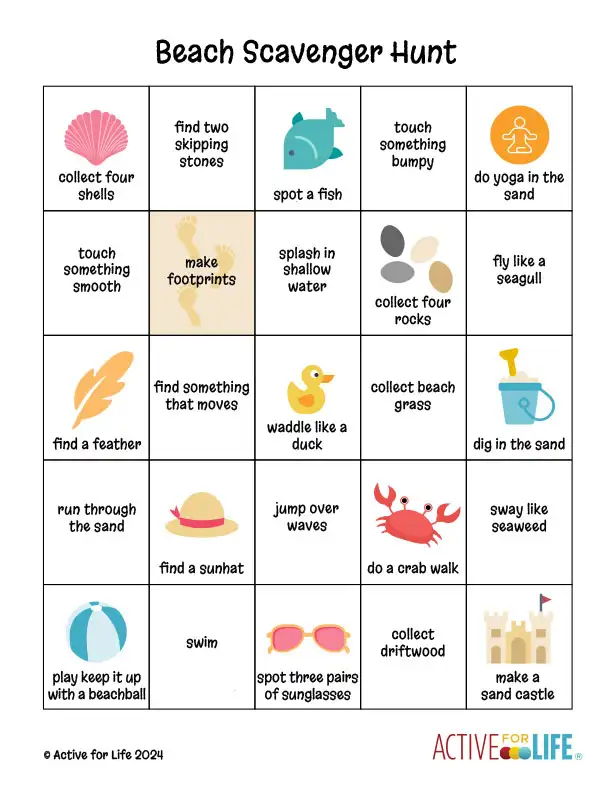
- Scavenger hunt: Similar to the above, you can create a beach scavenger hunt checklist based on your toddler’s interests, and help them find all the objects on it. Or print off our beach scavenger hunt below—winner gets an ice-cream!
- Drawing in the sand: Use sticks or fingers to draw shapes, letters, or numbers in the sand and practice those fine motor skills.
- Run and jump: Open spaces on the beach are perfect for running and jumping games, which improve cardiovascular health and leg strength.
- Beach gymnastics: Encourage your toddler to balance on logs or low rocks or climb on boulders (with supervision and water shoes). You can also encourage them to move their bodies in new ways, i.e., “jump on the sand” or “roll on the sand.”
What should I pack in my toddler’s beach bag?
You may have noticed that in order to do some of the activities above, you’ll need to bring along some toys. The good news? Toddlers don’t need expensive beach toys to have fun at the beach or practice those physical skills.
The bad news? Well, they are toddlers, after all. So, while that diaper bag has gotten smaller over the last year or so, a day at the beach means you’ll still have to bring quite a lot. This is to ensure your toddler is not just comfortable and safe while at the beach, but also has ample time to move and play. Here’s what to bring:
The basics
- A comfy bathing suit (or none at all): Depending on how old your toddler is, they may want to pick which bathing suit to wear. A rash guard can be great for sun protection, but you might even want to dress your toddler in clothes instead of a bathing suit for sun protection.
- Swim diapers: If your toddler is not yet potty-trained, bring plenty of swim diapers, especially if headed to a pool. Be sure to bring plenty of regular diapers as well.
- Wipes: When do you not need them? They can be especially handy at the beach.
- Extra towels: One for drying off and one for sitting on if needed.
- A spray/squirt bottle: For washing those little hands every time they get sandy.
- Snacks and water: Healthy snacks and plenty of water to keep your toddler hydrated and energized. Some good beach snacks that help toddlers keep sand out of their mouth are fruit/yogurt pouches, cheese sticks, cut-up fruit, rice cakes, pretzels, and wraps or tiny sandwiches.
- Extra clothes: A change of clothes for after swimming, including a lightweight long-sleeved shirt for extra sun protection, or something comfy for the car ride or walk home.
- First aid kit: Include basics like band-aids, antiseptic wipes, and any necessary medications.

For water & sun safety
- Sunscreen/sunstick: Consider using mineral-based sunscreens of at least 30 SPF. Look for water-resistant ones that are also coral-reef safe, and apply every two hours.
- A hat: If your toddler is anything like mine, they may be rather stubborn when it comes to wearing a hat. Try modelling the behaviour, let them pick a fun hat (or a few, as even if they pick one, they may decide as soon as you get to the beach that they don’t like it!), or at least have an umbrella, tent, or shady area they can be under when they aren’t in the water.
- Sunglasses: Protect your toddler’s eyes from the sun’s harmful rays. Look for ones that have both UVA and UVB protection. If the UV index is over 3, you’ll want to take all the sun safety precautions you can, and limit your sun exposure between 11 a.m. and 3 p.m., as the sun is strongest during this time. This goes for you, too!
- Water shoes: Whether it’s the hot sand, rocks on the beach, or to protect your little one’s feet from glass shards, water shoes are a great idea. They’re also perfect if you plan on doing nature hikes with swimming lakes and want an overall multipurpose shoe.
- Water floaties/life jacket: According to the Canadian Paediatric Society (CPS), “toddlers should always be within arm’s reach of an adult when they are in or around water.” Most toddlers are not yet swimming on their own, so you and them are likely more comfortable with a flotation device, which can be categorized as a PFD or lifejacket. These are different, but no matter which you choose, check to make sure it fits Canada’s current national safety standards and it’s the right size for your child’s weight. As the CPS advises: “Remember that water wings, neck rings, bathing suits with flotation devices in them, and other swim toys ARE NOT safety devices.”
- Safe swim toys: Most water toys are made for the pool, not open water. So, if you’re going to the beach, you may want to leave those water toys at home.
To relax & play
- A sand-proof blanket: Toddlers already get sandy enough, and let’s be honest, they’re not great at keeping sand off of the beach blanket. So, consider investing in a sand-proof, waterproof beach blanket!
- A shovel and small bucket: This is the only beach toy you really need at this age! We have more ideas below. Shovels are also good for practicing those fine motor skills.
- An umbrella/chair combination and/or tent: For added shade and comfort, consider bringing a beach umbrella/chair combo or a pop-up beach tent.
- Beach balls: Beach balls are a safe and fun toy you can bring to the beach. Plus, they are easy to pack!
What are some creative (free) toy ideas?
- Plastic containers and cups: Use these for scooping and pouring water or sand. Toddlers enjoy the simple action of filling and emptying containers.
- Kitchen utensils: Items like spoons, spatulas, and funnels can become fun beach toys.
- Empty water bottles: These can be used to collect small shells, sand, or water.
- Natural items: Collect shells, rocks, and driftwood to create patterns or small structures.
- Homemade sifters: Create sand sifters using old colanders or containers with holes poked in the bottom.

Other safety tips to keep in mind
As fun as the beach can be, it’s also a place where safety should be the number one priority. And, as some parents are focused on water and sun safety (as they should), don’t forget to zoom out. There are much broader concerns while at the beach:
- Sun protection: Apply sunscreen regularly, use hats, and seek shade during peak hours to protect your toddler from sunburn and heatstroke.
- Water safety: Monitor how long your child stays in the water and always keep an eye on them to prevent drowning accidents.
- Lifeguard check: Familiarize yourself with the locations of lifeguards on the beach and stay close to them for added safety.
- Water and beach hazards: Teach your child about the dangers of quicksand and avoid areas where it might be present. Additionally, be aware of any dangerous water conditions by knowing the signs and looking out for warnings.
- Crowded areas: Don’t only watch your child when they’re in the water. Children can get lost or go missing. Don’t lose sight of them.
- Parking lot dangers: Beach parking lots are also busy. Hold your child’s hand and stay alert to moving vehicles when navigating parking lots.
- Beach critters and sharks: Keep an eye out for critters like jellyfish, sharp shells, and other potentially harmful creatures that could cause injuries. (This is another reason why water shoes are a good idea!) And know which waters can be home to sharks.
- Choking: Choking is always a risk when toddlers are eating or playing with objects. Don’t forget to watch them even when they’re just relaxing.
- Hydration and breaks: Ensure your child stays hydrated and takes regular breaks to prevent exhaustion and overheating.
Be ready for your next toddler beach day
The beach is an exciting place for your child. And, once they learn what it is, chances are they’ll ask you again and again to go. Maybe “beach” will even be one of your toddler’s first words! (Mine started saying it a lot.) But it can be less fun for parents who feel like they aren’t able to keep their toddler entertained or are too nervous to let them have fun.
As long as you’re prepared with a beach bag checklist, aware of safety precautions, and armed with activity ideas to have fun—while practicing those physical and mental developmental skills—you have nothing to worry about. Consider taking turns with another trusted adult so you can enjoy the beach, too!


Much much better photo of a child well protected from the sun. Two thumbs up.