Fun basketball drills & games for kids
When my daughter was seven, she decided that basketball would be her new sport. She didn’t know a whole lot about the rules, but she’d watched other kids play, seen the Toronto Raptors on TV, and thought it would be fun to try.
But she managed to pick up the basics fairly quickly as she had learned and practiced many of the fundamental movement skills required for basketball well before she joined the game: jumping, throwing and catching.
These are groundwork movements that kids begin to learn very early on in life. And when a child can perform these movements, they can then move on to learning the skills of dribbling, passing, and shooting.
Whether they join a team or play in the schoolyard with friends or family, your kids can work on basketball drills anywhere (though you might want to avoid shooting practice inside your home!)
Size of basketball
Before your child begins any games or drills, it’s important to be sure they have a ball that’s appropriate for their age.
- For ages four and under, pick up a size 3 ball
- For ages five to eight, go with size 4
- For ages nine to 11, choose a size 5
FUNdamentals: Fun basketball games and drills
As with any sport, the more fun a kid is having, the more they’ll want to practice and play. When they’re learning about the fundamentals of basketball, keep the focus on fun while they’re taking part in these engaging, skill-building games and drills.
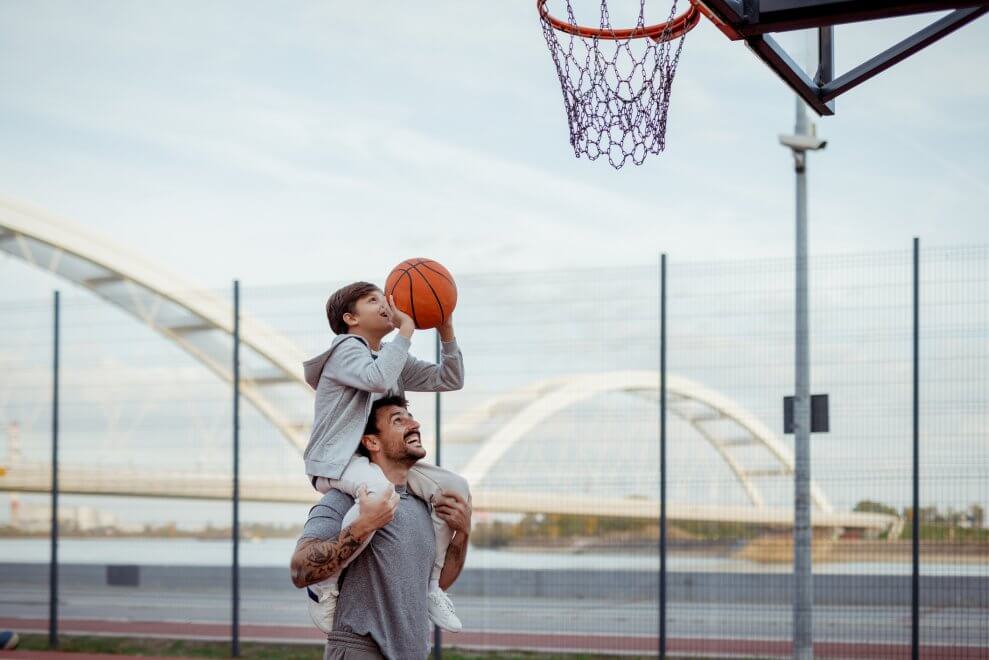
Dribbling
Dribbling in basketball is the act of bouncing the ball with one hand with fingers spread apart so the ball is touching the fingertips. Once kids get comfortable dribbling, they can then start to practice moving with the ball.
Pat-a-Cake: Introduction to dribbling
To get your kids comfortable with the action of dribbling, have them bend their knees slightly and hold a basketball in one hand at waist height. Have them then bounce the ball up and down using the palm of their hand with their fingers spread out to pat it (not slap it) each time it gets to their waist.
Make sure that your kids are using their arm from their elbow down each time they bounce the ball with their hand and not just using their wrist.
As they get more comfortable with the movement, they can recite the pat-a-cake rhyme as the ball goes up and down. Have them practice this movement with each of their hands and see how many times they can bounce it in a row with each hand.
Initially, your kids will watch the ball as it moves. Challenge them to start patting the ball with their eyes up. It might take a bit for your child to develop this skill and they’ll likely go back and forth between watching the ball and keeping their eyes up. With practice, though, they will eventually be able to keep their eyes up consistently.
High! Low! Go! Learning to dribble at knee height
When playing basketball, there will be times your player will want to dribble the ball at waist height and times to dribble the ball around or beneath the knees. When the ball is dribbled lower down, there will be less room between the ball and the floor for other players to reach in and take the ball away.
Have your kids practice low dribbling with their feet apart and their knees bent. To practice dribbling both low and high, play this Freeze-Dance-like game.
On the count of three, have your kids start dribbling the ball while standing up. Have them dribble like this for about 10 bounces then call out, “Low!” Your kids should then start to bend their knees fully and dribble the ball down low.
Alternate with the number of bounces between calling out “High” and “Low” and soon your kids will be transitioning between pulling the ball up quickly between each type of dribble. Warning: This game might elicit giggles as they try to move from one position to the next!
Cross it up! Learning to dribble across the body
The crossover dribble—moving the ball from one of their hands to the other across their body—is a key skill for your kids to learn. It’s a great way to keep other players guessing where the ball is going to go. And it’s easier to protect the ball from another player reaching in to get it if you can move it from side to side.
Have your child bend their knees and hold the basketball in one hand. Get them to bounce the ball between their feet as they push it towards their other hand. When they catch it with the other hand, have them repeat the bounce in the middle and then push it back towards the other hand.
Watch this with your kids to see kids learning to do a crossover dribble:
To get your kids focused on doing the move, have them chant a short, easy cue such as, “bounce left, bounce right,” as they bounce between their feet to their left hand then bounce between their feet to their right hand.
They could also try repeating, “tick tock, tick tock,” as they move the ball back and forth.
Advanced dribbling drills
When your kids have become comfortable with dribbling, dribbling high and low, and crossover dribbling, they can then try some more advanced skills development.
Moving dribble
Have your child practice walking or running while doing basic dribbling. Set up cones far apart and have your kid move from one to the other.
Around-a-defender dribble
In a basketball game, you have to move around other players to get to the net or to a spot where you can pass to a teammate. Set up a series of cones (defenders) and have your child move around them by walking and dribbling with one hand and then the other. When they’ve mastered the move, can they do it more quickly?
Dribble between legs
When kids learn to dribble the basketball between their legs, they’ll be able to change their direction more quickly and keep opposing players from reaching in to take away the ball.
Have your child start by standing with their feet wider than hip distance apart, their knees bent and their bums back so they’re in a low stance. Make sure they keep their chin and eyes up.
With the ball in one hand, kids should snap their wrist down while bouncing the ball through their legs and catching it with the opposite hand by their leg. Make sure they’re using the tips of their fingers instead of the palms of their hands to bounce the ball. They should then do the same move in reverse.
Once this move has been mastered, kids can start moving forward by placing one foot forward and the ball in their opposite hand. Have them practice this until they’re comfortable and they can then begin to walk forward while crossing the ball between their legs.
This might take a while (and perhaps some frustration) to manage. Remind your child that this is a power move that takes a lot of people time to figure out! Watch this video to see one coach’s tips:
Passing
Since basketball is a team sport, kids need to learn to pass the ball from one to another to move up the court. The best passes to learn as a beginner are the chest, bounce and overhead passes. And the absolute best passes are ones that your teammates can catch!
Chest pass
A chest pass involves passing the ball from your chest level to your teammate’s chest.
Have your child stand tall and grip the ball on its side with their fingers spread and their thumbs down. They should then step forward with one foot and push the ball towards their teammate. Encourage your child to follow through with their pass (have their hands finish outstretched towards their teammate’s chest).
The back of their hands should be facing each other once they have passed the ball. Emphasize that the ball should be passed or pushed in a straight line so it ends up in their teammate’s chest. Watch how these girls practice their chest passes:
If your child doesn’t have anyone to pass with, they can always practice their chest passes against a wall.
Bounce pass
The aim of the bounce pass is the same as a chest pass. Your child wants to pass the basketball to their teammate so that they can catch it cleanly.
Have your child grip a basketball with their fingers on each side of the ball. They should then step forward with one foot and push the ball down to the ground about halfway or three-quarters of the way between them and their teammate. The aim is to have the ball bounce up to the teammate’s waist.
When your child has mastered bounce passing with two hands, see if they can use one hand to bounce the ball to their teammate. Watch as a coach performs bounce passes with a player:
Overhead pass
When you need to get the ball far down the court or over the head of the opposing players, an overhead pass is a great option.
Have your child hold the basketball with two hands above their forehead. Make sure the ball isn’t behind their head as it could be easier for an opponent to steal it. Have them take one powerful step forward towards their teammate and aim for their chest or chin. Make sure they follow through with their arms as they pass the ball.
Again, this is a pass that can be practiced with another person or against a wall. If your child uses a wheelchair, here’s how they can practice this skill. Watch as a Jr. NBA coach teaches a player how to pass the ball overhead:
Passing games
Once your kids have mastered the chest, bounce and overhead passes, they can use them in some fun games as a way to practice their skills.
Monkey in the Middle
In this game, three kids will be the passers and one will be the monkey. Have the three passers spread out into a triangle with the monkey in the middle of their group. The passers must get the basketball to each other without the monkey catching it.
The passers can use chest, bounce or overhead passes to try to keep the ball away from the monkey and can move around the triangle to make their passes. If the monkey catches the ball, the last player to have thrown it becomes the monkey.
Simon Says – passing edition
With at least four players, split up the kids into teams of two. Choose an extra player or adult to be “Simon.” Line up the players from each team about eight feet across from each other and begin the game.
Simon must call out pass commands: “Simon says chest pass,” “Simon says bounce pass,” and “Simon says overhead pass.” Players must then perform the action that Simon has said.
If they use a different pass, they and their teammate are out until the next round. Mix it up to keep players on their toes by calling for the same passes two or three times in a row. If Simon calls out a command without using the words, “Simon Says,” and a player passes the ball, that player and their teammate are out until the next round.
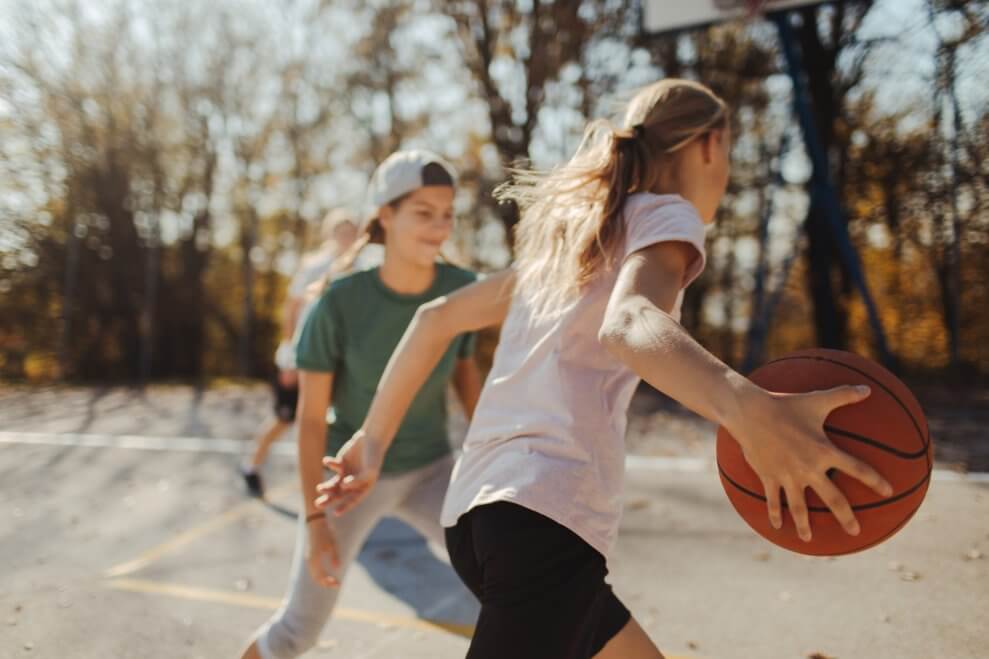
Shooting
When first learning how to shoot a basketball, the goal is to teach your child how to shoot properly from a short distance before they move further out from the basket.
If you have a low basketball hoop or can lower a hoop in a gym or park, this is the best start for a child. Have them stand two to three feet away from the basket while they’re learning the fundamentals.
Show your child how to hold the ball by having them place their dominant or shooting hand (the one they write with or brush their teeth with) on the back of the basketball with their fingers spread and their other hand on the side of the ball.
Have them stand with their body facing the basket, their feet shoulder width apart and their knees slightly bent. Holding the ball near their chest or face, have your child bend their knees further and then push up using the power of their legs while they keep their eyes on the basket (not on the ball).
With their elbow directly under the ball, have them push the ball up with their shooting hand. At the end of the motion, your child’s arm should be straight, their wrist should be floppy and relaxed and their fingers pointing at the basket. Kids should stay frozen in this position until the ball has landed.
Jumping with the ball can come later, after your kid has mastered the basic shooting skills.
Shooting games
Basketball drills designed as games will help kids develop their shooting abilities while having fun!
Colour-to-colour run & shoot
Spread pieces of construction paper or pieces of felt of various colours all around the basket. When you call out a colour, your child must run to that colour and attempt a shot. Leave lots of room between the colours so your child gets to run from spot to spot. With several kids, have them take turns of a minute of shooting before moving to the next child.
Frozen statues
Remind your player that they should freeze after they shoot the basketball. Have kids take shots one at a time and see how long they can hold their frozen position while the other players try to make them laugh and “unfreeze.” (No touching each other allowed!)
Before you play another shooting game in the future, give your kids a short reminder of how they should hold the ball, bend their knees, push the ball with their eyes up and finish the shot with their arms outstretched. Keep it simple by having your kids repeat, “hold, bend, push, release!”
Remember to keep the emphasis on fun for all of these basketball drills and games!