Rewilding childhood: How to make play more fun for kids
This is a condensed excerpt from Josée Bergeron’s new book, Beyond the Front Door: Embracing Nature for a Happier and Healthier Family. In it, Bergeron shares simple ways that families can increase outdoor time and improve mental health, and she includes fun activities for every season. Excerpt printed by permission of Morehouse Publishing, an imprint of Church Publishing, Incorporated. (c) 2026 by Josée Bergeron.
“Can we play, pleeeease?” my 11-year-old son begged. I looked over his shoulder to see his two friends flanking him.
“It’s a hard no,” I answered.
“Just this one time, because my friends are here. . . only for an hour,” Theo persisted.
“Don’t even try,” my teenage son Felix chimed in. “She won’t budge on this one.”
I hoped he was right. At the start of spring break, our family decided to take a break from screens. I knew without a doubt that too much screen time and not enough green time had been having a negative impact on our family.
“Why don’t you go play outside instead,” I encouraged my son and his friends. “It’s a beautiful day. I’m sure you’ll find something to do.”
Defeat furrowed on their faces, they slipped on shoes and reluctantly stepped outside. A few moments later, hooting and hollering seeped through the open window like a fresh spring breeze.
We often hear that “play is the work of childhood,” a quote attributed to renowned Swiss psychologist Jean Piaget and sometimes to the Italian educator Maria Montessori. I often see this quote shared on social media, but I’m not sure they ever said it. I can’t find evidence they did. In fact, I hope they didn’t because for children, play is not work.
Play is a child’s way of being—it’s the heart of a child. That’s why in 1989, the United Nations included Article 31 in the Convention on the Rights of the Child, which states that children have the right “to rest and leisure, to engage in play and recreational activities appropriate to the age of the child.”
Play is how children learn about the world, about themselves, and about others. It’s how they develop all the important skills they will need as adults. Play helps children learn how to regulate emotions, develop social skills, build healthy bodies, and grow creativity, problem-solving skills, and so much more. That’s why children need plenty of time to play.
Peter Gray, research professor at Boston College and author of Free to Learn, describes the characteristics of play as being:
- Self-chosen and self-directed
- Intrinsically motivated—not forced
- Guided by children’s own mental rules—adults don’t make the rules
- Imaginative—anything is possible!
In other words, children engaged in play must be free to choose when, what, and how they play. Most importantly, play must be fun!
3 ways to make play more fun
1. Bring play outdoors
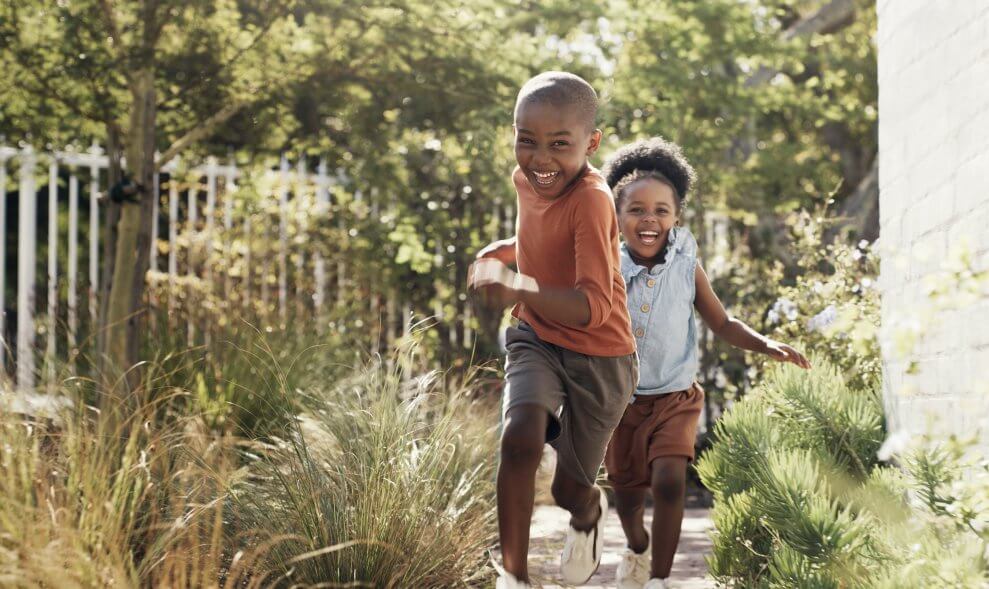
Great play can happen indoors, but in the arms of nature I’ve noticed that children play differently. There’s an unrestrained joyfulness in outdoor play. Children move more, speak louder, and create mess—and it’s OK! The natural world is filled with open-ended materials, elements that challenge and stimulate the senses. All this helps to promote physical activity, cognitive development, and creativity.
If there’s one characteristic of play that I would add to Gray’s list, it would be this:
5. Connected to nature
The natural world supports play in its wildest form.
2. Allow “risky play”
Watching my 18-month-old run at increasing speeds down a small ramp while simultaneously watching my 16-year-old climb high into a willow tree made me break out into a cold sweat. If there’s one thing that kids love that causes parents, caregivers, and educators to feel uncomfortable, it’s taking risks in play.
Risky play is defined as a thrilling and exciting play where kids encounter unknowns and possible hazards that carry a risk of physical injury or of feeling afraid. The word “risky” is often seen as something negative in our society, so much that some parents don’t like the term “risky play.” Risk can lead to loss or injury. Something best avoided, especially for children. However, risk can be positive too. Learning, innovation, problem-solving, and discovery only happen by taking risks.
In fact, children use risky play to manage their fears and build confidence. Children climb up trees to quell fear of heights, sled down snow hills to feel confident with speed, or catch spiders to feel brave around insects. Some parents worry that if their child gets injured while engaging in risky play they will develop fears and phobias, but the opposite seems true—children that don’t engage in risky play are more likely to develop fears and phobias and even get injured.
A great guiding mantra for parents is as safe as necessary, not as safe as possible. Unless the risk for significant injury is real, give your child space to take risks and watch how proud they are when they do accomplish something challenging.
It’s true that sometimes children need help to better understand a risky situation. If this is the case, you can help your child foster awareness or develop problem-solving skills by prompting them with a question or statement such as:
- Notice how . . . these rocks are slippery, the log is rotten, that branch bends.
- Do you see . . . the poison ivy, your friends nearby before throwing that rock?
- Try moving . . . your feet slowly, carefully, quickly, strongly.
- Try using your . . . hands, feet, arms, legs.
- Can you hear . . . the rushing water, the wind whistling, the fire crackling?
- What’s your plan . . . if you climb that boulder, cross that log?
3. Add loose parts
“If you could design your dream playscape, what would it look like?” I asked my eldest daughter.
“Well, there would be some nice trees to climb, for sure. A nature kitchen with jars filled with leaves, herbs, berries, pebbles, shells, and honey for making things. I would also like a place to swim. Not a swimming pool but a place with water, sand, shells, and a big waterfall. Oh! Don’t forget a trampoline too,” she replied with twinkling eyes.
A group of Australian children were asked a similar question. The study took place at a shopping mall in Sydney, where 110 children were asked to design their dream playground for an area of the mall undergoing renovations. Every single picture focused on nature elements like rocks, sticks, sand, and leaves. Other than nature, the two most commonly drawn things were play equipment that encouraged risky play and “active play” elements like props for imaginary or creative play. In other words, children dream of playscapes that are outdoors, have risky play elements, and include loose parts.
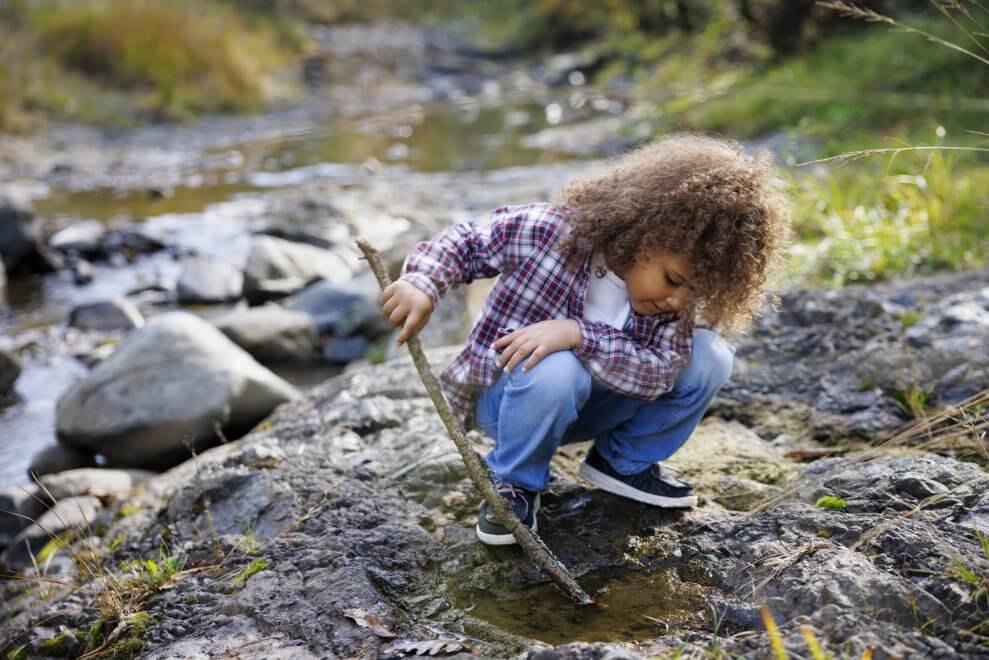
I’ve noticed that most children are naturally drawn to loose parts when they play. Loose parts fill kids with a sense of curiosity and imagination. Playing with loose parts has also been shown to encourage physical activity and movement; foster problem-solving skills, creativity, and exploration of the environments; and stimulate social interaction, language use, risk taking, and inclusivity.
Embracing the wild side of play
Rewilding play needs to be a movement beyond front doors, one rooted outdoors where children can have the freedom to be children. While play can happen indoors, sending play outdoors allows play to unfold in ways that can’t be replicated indoors, all the while depending on our children’s bond with the natural world.